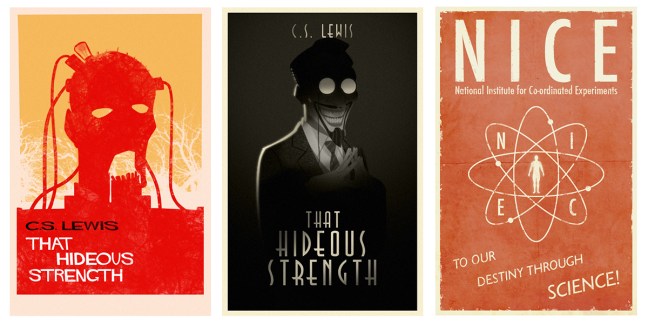
By C.S. Lewis
A Modern Fairy-Tale for Grown-Ups
Though George Orwell may not agree, fairy-tales and fantasies can be just as relatable and truthful as any other genre. In the preface of That Hideous Strength, C.S. Lewis remarks that fairy-tales usually have very “commonplace” beginnings, and “ha[ve] behind [them] a serious ‘point’,” (Lewis 7). The humble beginnings of a fairy-tale, though often overlooked, are necessary to prove such a point. They introduce the realism of the story, what often ends up being at the heart of the story. That Hideous Strength is no exception. The novel begins with Jane, (a plain name), “wast[ing] another morning” thinking about how lonely and aimless her life has become since her marriage (12). It is a seemingly mundane setup, for although it is outlining a quiet tragedy of a neglected wife, nothing particularly extraordinary has occurred. This introduction of an ordinary day is crucial because it introduces the relationship of Jane and Mark, and sets up how Mark is losing sight of what is important in his ambitious haste. Mark’s blinding ambition leads him to hit rock bottom, almost convinced that he is just a pawn in some unstoppable cosmic plan, fighting what seems to be a losing fight. It is at this pivotal moment that Mark finds his strength in “something he vaguely called the “Normal”,” which he associates with “fried eggs and soap and sunlight…” and, most importantly, Jane (296, 297). He chose the side of the Normal, opting to fight for some of the most basic aspects of humanity; most importantly, he chose to fight for love. The contrast of the enormous cosmic battleground filled with fantastic players against the extraordinarily ordinary humanity of Mark’s decision emphasizes the importance and beauty of humanity. This is the point C.S. Lewis wanted to make: that humanity is something too important and too beautiful to let “scientific progress” destroy. Although other genres may be capable of effectively making this point as well, fairy-tales are especially effective because they assign one party to be the “good guys” and the oppositional party to be the “bad guys”. This clearly establishes that the moral ideology of the good guys is inherently good and that the moral ideology of the bad guys is either evil or misguided. Since Mark and Jane come to serve as representatives for humanity, the preservation of humanity is structured to be the good idea, and the destruction of humanity is built in as the evil plan the heroes must stop. The simplicity of the good-versus-evil structure of this modern fairy-tale introduces and reinforces the moral of the story: that humanity should fight the abolition of man.
 Mad Science In The Mirror of Art